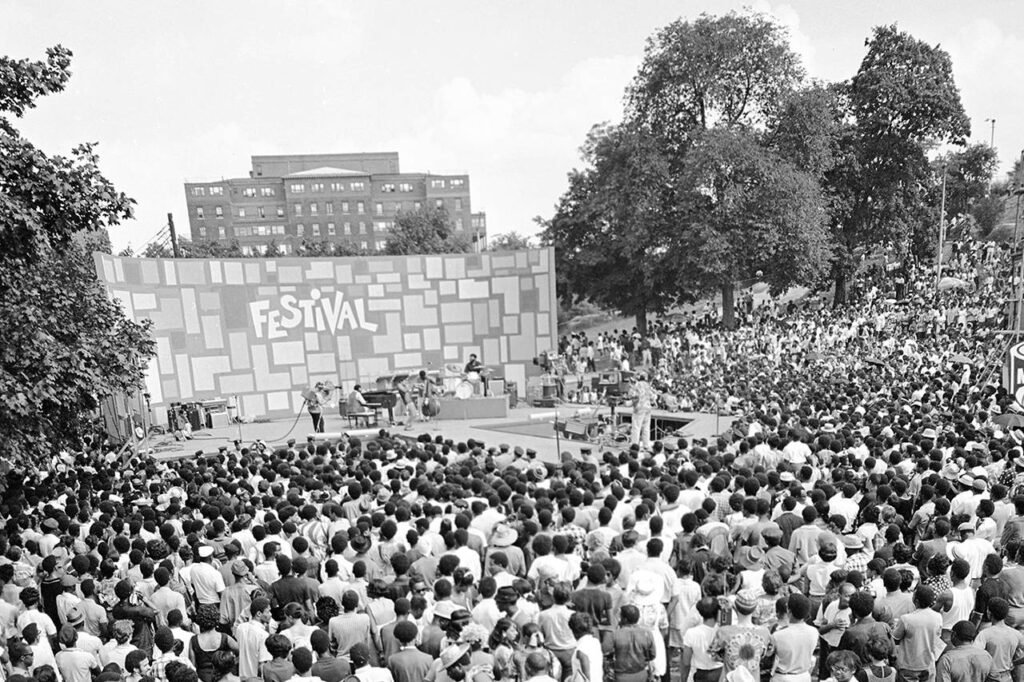
Before the 1969 Harlem Cultural Festival became one of the brightest—and simultaneously most overlooked—moments in the history of Black music, there was a long road paved with vision, stubborn hustle, and sheer community will. The spark came from Tony Lawrence, a singer, hustler, organizer, and Harlem character with charisma for days and an obsession with turning the neighborhood’s cultural reality inside out. This wasn’t some big-budget impresario. This was a man who simply understood that Harlem deserved to see its own greatness reflected on a monumental stage.And somehow, in the tense atmosphere following the assassination of Dr. Martin Luther King Jr., Lawrence convinced the New York City administration—headed by Mayor John Lindsay, a white liberal politician navigating a racial powder keg—that backing a major Black cultural event might actually build bridges instead of break them. It was a gamble. A risky one.
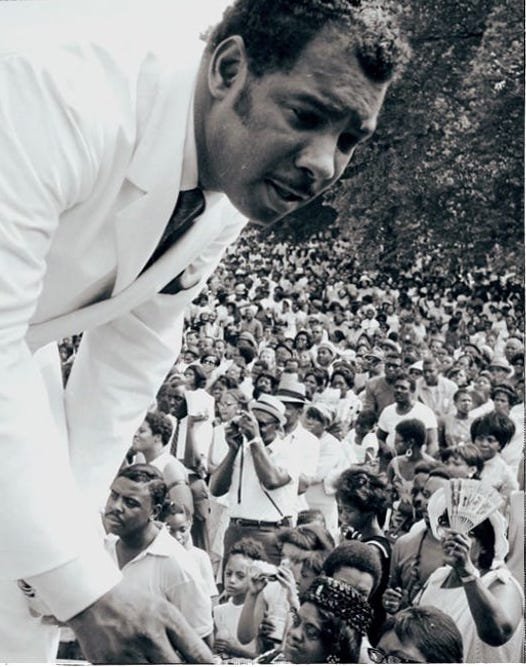
The obstacles were endless: tiny budgets, institutional skepticism, the city’s fear of mass Black gatherings in public spaces, and the inevitable battle with media outlets far more interested in broadcasting riots than joy. But Lawrence wasn’t alone. Hal Tulchin—the man who filmed the entire festival—became a crucial partner, even though the footage would later spend decades buried in basements as if the industry had collectively agreed to forget it existed. The Harlem Cultural Festival emerged out of necessity and defiance. A declaration. A loud “we’re here, and we are magnificent,” delivered right before Black music exploded onto the global stage.
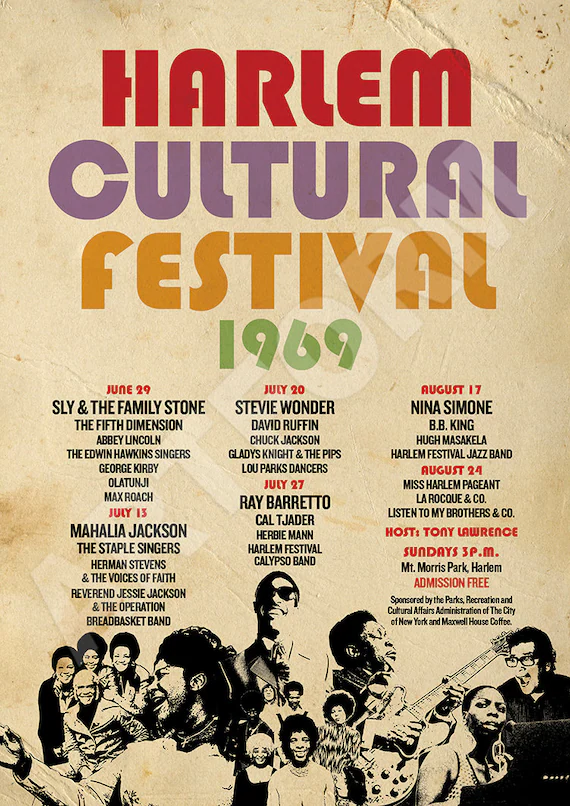
If the festival looks mythical now, imagine what the preparation felt like. Convincing some of the most important artists of the era to play Harlem for free or nearly free wasn’t a matter of logistics—it was a political statement. The lineup read like an impossible dream: Stevie Wonder, Nina Simone, B.B. King, Gladys Knight & the Pips, The 5th Dimension, Sly & the Family Stone, Mahalia Jackson… and that’s just scratching the surface.
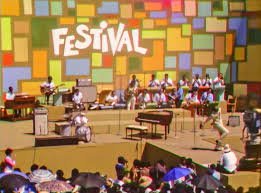
Meanwhile, behind the scenes, creativity collided with guerrilla logistics. No Woodstock-style budget. No army of technicians. What there was: neighborhood power. Churches brought people. Local organizations handled safety. Small businesses chipped in resources. A community built that festival piece by piece. And yet, the technical quality of the recordings—thanks to Tulchin’s vision—was stunning. Lawrence transformed Mount Morris Park into a sound sanctuary with scraps, hustle, and a whole lot of belief. That combination—outrageous talent, community ingenuity, and a spirit of resistance—gave the festival its one-of-a-kind essence.
This wasn’t “just music.” It was Black history unfolding in real time, unfiltered, unbothered, unapologetic.
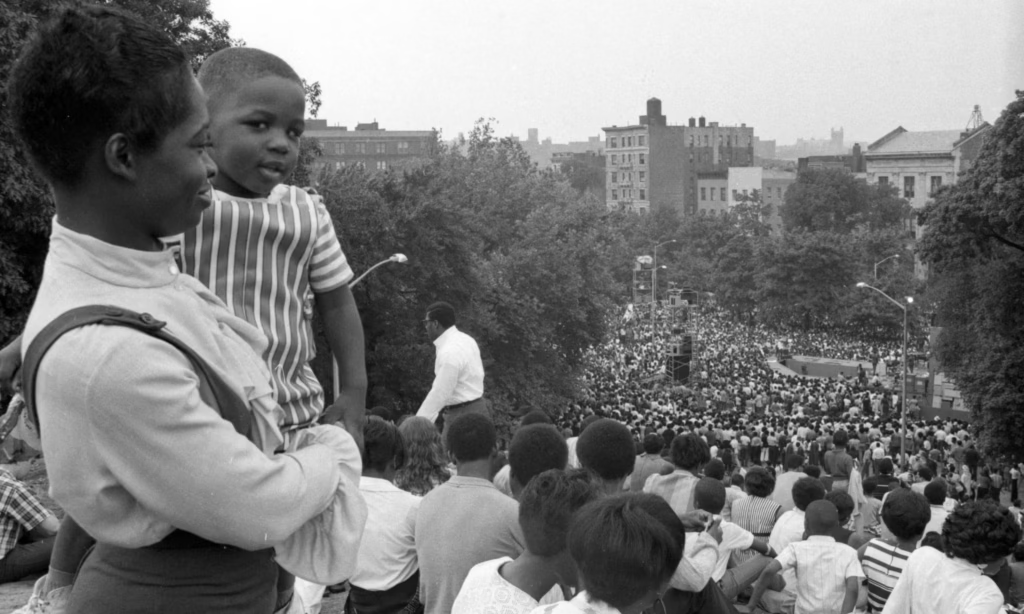
Across six Sundays, from June 29 to August 24, 1969, the Harlem Cultural Festival unfolded not as a linear concert series, but as a layered spiritual and political journey. June 29, the opening day, was not just gospel—it was a collision of worlds. Sly and the Family Stone detonated a new sonic future, blending funk, rock, and psychedelia into something radical and borderless. Alongside them, The 5th Dimension embodied a different kind of breakthrough—polished, crossover, and quietly revolutionary in how Black artistry moved through mainstream space.
But the spiritual core was undeniable: Edwin Hawkins Singers lifted the crowd into collective ecstasy with “Oh Happy Day,” while figures like Max Roach and Abbey Lincoln grounded the day in political jazz and Black consciousness. It wasn’t just an opening—it was a declaration.
July 13 shifted the entire register into sacred ground. This was the true gospel summit. Mahalia Jackson—“the Voice of God”—transformed the park into something closer to a revival than a concert. When she sang, it wasn’t performance; it was testimony. The Staple Singers bridged the sacred and the political, their sound inseparable from the civil rights movement itself. And Jesse Jackson brought the message into sharp focus—connecting faith, music, and liberation with the authority of lived struggle. Harlem that day didn’t just listen—it affirmed.
July 20 marked the arrival of soul at its most electrifying and complete. A young Stevie Wonder stunned the audience—not just with vocals, but with musicianship that hinted at the genius to come. Gladys Knight & the Pips delivered precision and emotional force in equal measure, while David Ruffin carried the legacy of Motown with raw, magnetic intensity. This wasn’t just a showcase—it was a statement of dominance. Soul music had fully arrived as both art and identity.
July 27 expanded the geography of Black music. The festival turned outward—toward the diaspora. Mongo Santamaría and Ray Barretto brought Afro-Caribbean rhythms into the heart of Harlem, while Herbie Mann blurred genre boundaries with fearless improvisation. This was not just jazz—it was transnational dialogue. Harlem became a node in a global Black and Afro-Latin conversation.
August 17 carried the weight of history, struggle, and confrontation. B.B. King delivered blues that felt ancient and immediate at once, each note bending time itself. Hugh Masekela connected Harlem to apartheid-era South Africa, making clear that the fight for Black liberation was global.
And then came Nina Simone. Her performance did not seek approval—it demanded awareness. Mixing poetry, fury, and razor-sharp clarity, she turned the stage into a platform for political awakening. When she asked, “Are you ready, Black people?” it wasn’t rhetorical. It was a call to consciousness.
August 24, the closing day, remains partially obscured—but no less symbolic. The group Listen My Brother—featuring a young Luther Vandross—represented something different: continuity. Youth. The next wave. So, after weeks of gospel, soul, jazz, blues, and revolution, the festival closed not with a singular climax, but with a quiet passing of the torch.
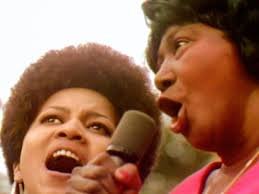
The Harlem Cultural Festival wasn’t just another event. It was the largest mirror ever held up to Black America in the 20th century. A sanctuary carved out at a time when the country was breaking along racial lines. While the world fixated on Woodstock, Harlem claimed its identity, its music, its grief, its faith, its joy—in a language outsiders weren’t ready to hear: music as resistance, music as healing, music as community.
The festival captured a turning point in Black music. Gospel tradition, soul power, funk electricity, pre-fusion jazz, ancestral blues—all coexisting on one public stage. It was a sonic laboratory of Black pride and a reminder that Black music isn’t just entertainment. It’s history. It’s prophecy. It’s the future being written note by note.
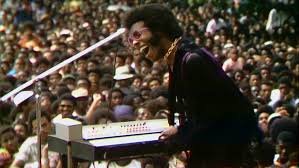
Today, its importance hits on two levels:
• Musically, it documented a moment when Black sound was evolving into the global pulse of popular culture.
• Politically, it offered a balm to a wounded community, gathering generations into a unified voice of dignity and defiance.
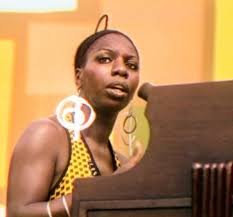
And thanks to the documentary of “Summer of Soul”, we no longer have to imagine it. Questlove resurrected a treasure that the world intentionally buried—a living monument, a celebration without precedent, and a timeless reminder of what happens when Black music speaks from a place of truth. He took Hal Tulchin’s forgotten archive and handed Harlem its rightful monument. The film shook audiences, critics, musicians—finally framing the festival not as a footnote, but as a central chapter in American cultural memory.
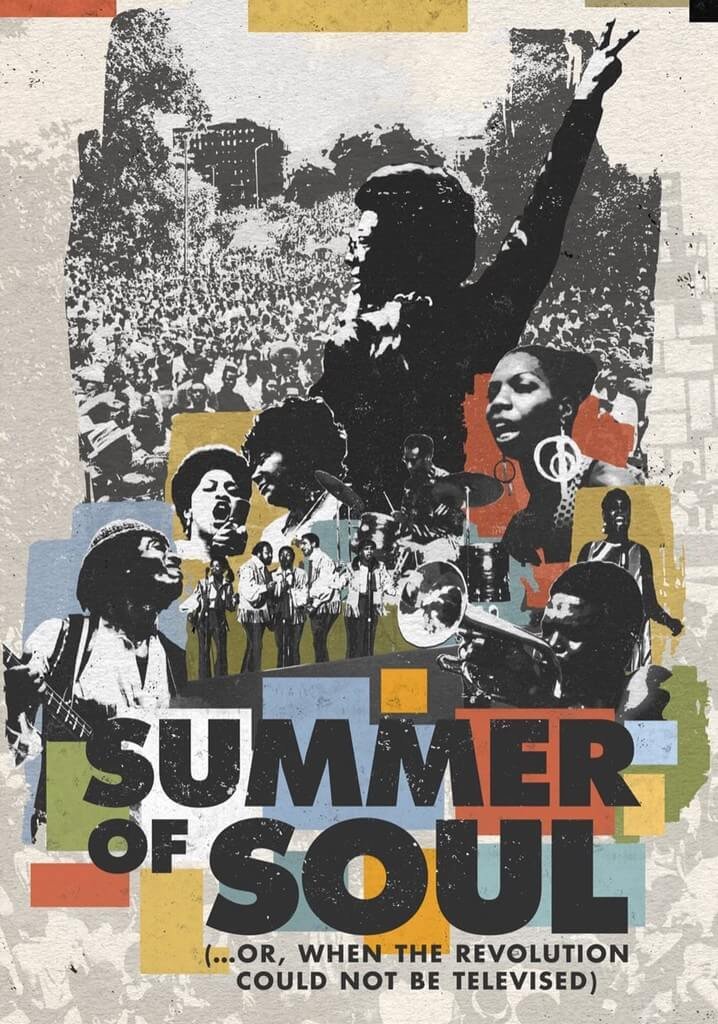
Today, as Black music continues to shape global sound, Harlem ’69 stands as a North Star. A reminder of what happens when a community gathers, sings, resists, and dreams together. The echoes of that summer still vibrate in every crate-digger’s playlist, every gospel sample, every funk revival, every jazz fusion experiment, every protest song sung with a trembling fist.
Because when Black music speaks as one voice, it doesn’t fade—it becomes generational truth…
 English
  Spanish