
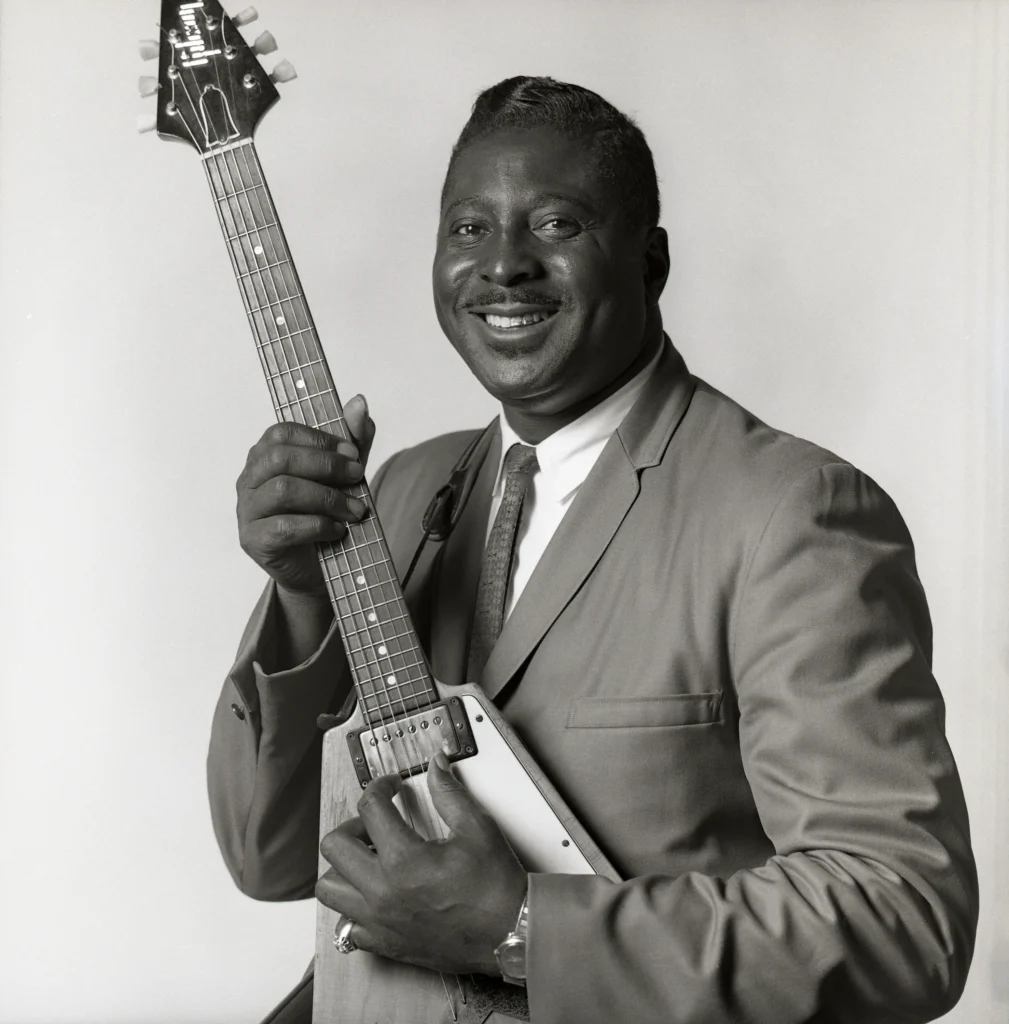
Albert King didn’t just arrive in the blues — he loomed into it, like a storm rolling in from the Arkansas Delta. Born Albert Nelson in 1923, in Indianola, Mississippi — the same town connected to B.B. King — he grew up surrounded by church shouts, field hollers, and the hard rhythms of Jim Crow America. His family moved constantly, chasing work, chasing survival, but no matter where they landed, music was the one thing that stayed steady.
Albert was a big man even as a kid — quiet, reserved, but observant. He started on a homemade guitar built from a cigar box and a piece of wire, playing it left-handed and upside down — a detail that becomes central to his legend. Because Albert didn’t have teachers in the formal sense. His mentors were the men on the street corners, the gospel women shouting the notes no one could write down, and the raw blues he heard coming off phonographs powered by car batteries.
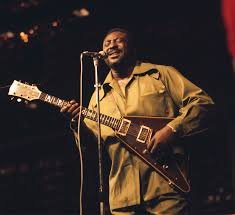
He listened to Lonnie Johnson, Blind Lemon Jefferson, and especially T-Bone Walker — but Albert absorbed them in pieces, never fully adopting anyone’s phrasing. Instead, he carved out his own universe. His tone wasn’t like B.B.’s regal precision or Freddie’s fast fire. Albert was a moan, a cry, a lazy backbeat bent into steel, something between a human voice and a freight train.
By the late 40s he moved north to Indiana and St. Louis, where he was finally noticed. His size, his sound, his stance — everything about him screamed unconventional blues giant. When he renamed himself Albert King, people assumed he was B.B.’s half-brother. He didn’t correct them. He just smiled, bent a string until it wailed, and let myth do its job. By the early 60s, Albert wasn’t just emerging — he was inevitable.
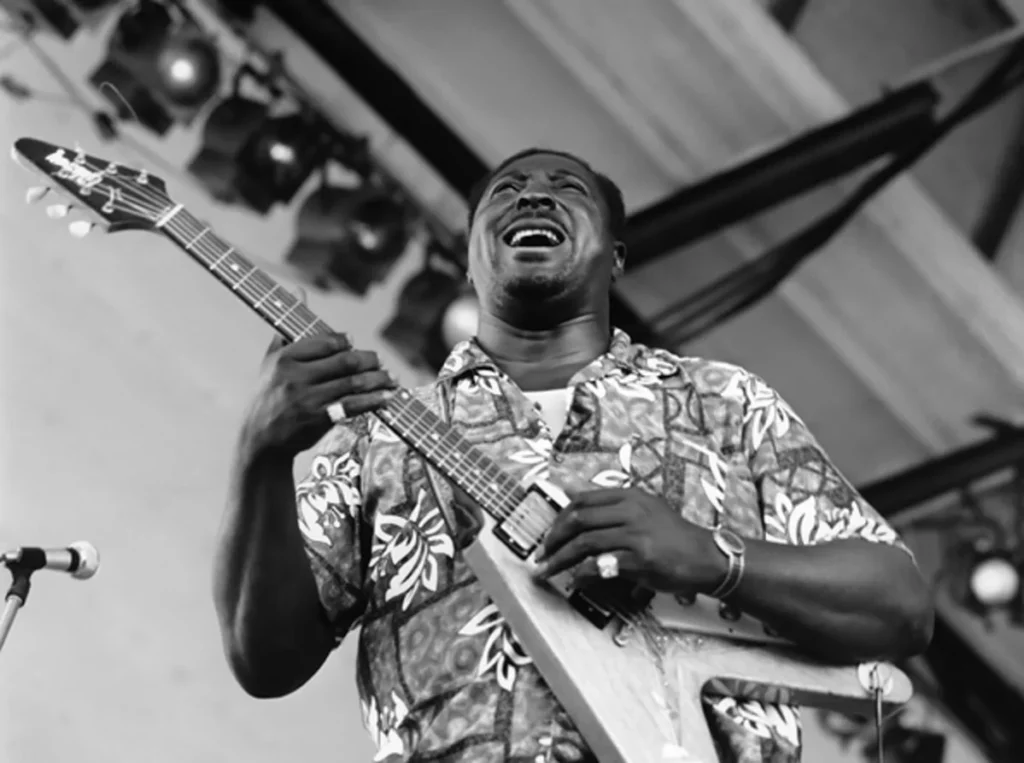
Albert King didn’t climb the ladder — he broke it, strapped it to an amp, and set it ablaze. The 1960s were his launching pad, especially once he signed with Stax Records in Memphis. Booker T. & the M.G.’s became his studio band, and that synergy alone could have changed the world. What happened instead was bigger: blues modernized overnight.
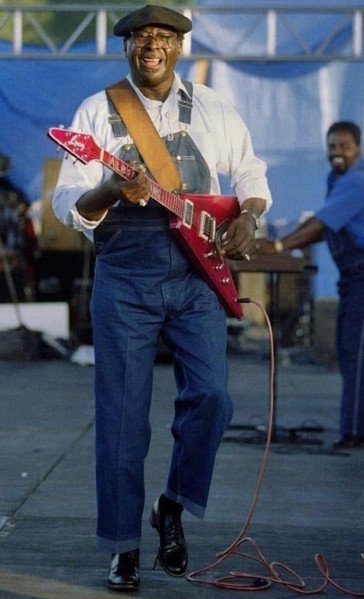
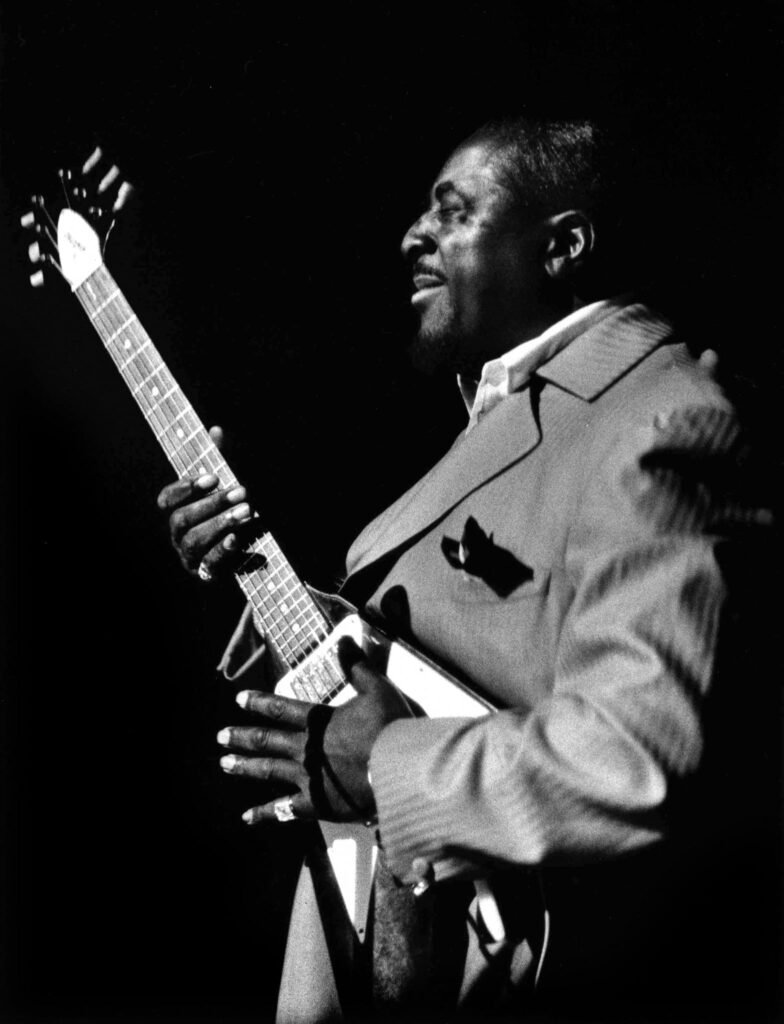
The key factor behind Albert’s rise was his tone — that sharp, vocal, bending-into-the-sky cry that no one else could imitate. Playing a Gibson Flying V flipped upside-down, Albert bent notes upward in a way right-handed players couldn’t touch. He also used light strings, practically sewing-thread gauge, which let him pull off bends that soared past the usual blues vocabulary.
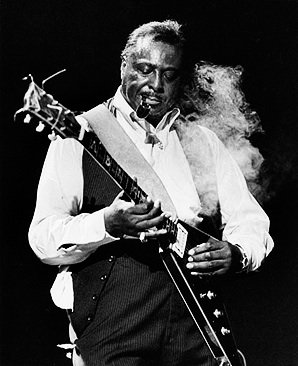
His attack was minimal but deadly — no running up and down the fretboard like Freddie, no endless vibrato sermons like B.B. Albert was space, tension, the long pause before the emotional punch. That’s why soul musicians loved him, why funk admired him, why rock stole from him without shame.
And then came the hits like “Born Under a Bad Sign” , a groove so heavy it changed the gravitational pull of American music; “Crosscut Saw” , a swaggering blues-funk hybrid ahead of its time or “Oh Pretty Woman”, not the Roy Orbison tune, but a blues so dirty it made amplifiers blush.
Albert didn’t just influence guitarists. He influenced entire genres. Without Albert King, the electric blues revolution of the late 60s doesn’t explode. Without Albert, rock guitar phrasing doesn’t take the turn it took. Without Albert, half of Clapton’s vocabulary doesn’t exist, Stevie Ray Vaughan doesn’t bend notes the way he does, and every modern blues player loses the blueprint for the “big cry” — that emotional howl Albert perfected.
Albert King’s recording career is a roadmap for the evolution of post-war blues. His early records on small labels set the stage, but Stax-level production and the Memphis groove locked him into immortality. As the years went by, Albert didn’t chase trends. Instead, he let trends come begging. He worked with soul bands, funk bands, even horn-driven units that brought jazz sensibility to his thunderstorm tone.
From all his essential albums, brushstrokes can be subtracted to understand his musical arc: From it electric and sharp rawness at its origin, trough the development of the electric blues, moving towards a Blues with more groove and greater depth , with socio-political and cultural glimpses loaded with intention, at times elegant, urban and irresistible…, up to his later Blue, fiery still.
And of course, the legendary live sessions like Fillmore Auditorium, Montreux, Japan, the Chitlin Circuit, and countless roadhouse burns that never made it to tape. Albert’s collaborations stretch across black music like veins of electricity. He recorded with Booker T. & the M.G.’s, jammed with Steve Cropper, traded licks with John Mayall, and became the spiritual father of Stevie Ray Vaughan — officially documented on In Session (1983), one of the most important blues recordings ever captured.
Albert King lived the blues with the intensity of a man who didn’t plan for tomorrow. His touring schedule through the 70s and 80s was relentless — hundreds of shows a year, long sets, heavy amps, and even heavier expectations. He treated live gigs like a battlefield: he played loud, he played long, and he played like he had something to prove every single night.
Those who toured with him say Albert could be tender or terrifying, depending on the day. He was a perfectionist. If the band missed a turnaround, he’d let them know with a glare that could burn through plywood. But when the groove hit? Albert turned stages into cathedrals. The lifestyle — the road food, the long drives, the physical weight of constant performing — eventually caught up with him. Albert passed away in 1992 at 69 years old. Not “young” by blues standards, but young enough that the world felt robbed.
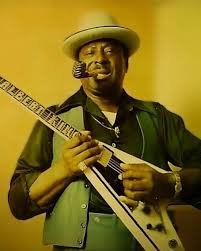
His death wasn’t sudden in the dramatic sense, but it hit like a punch in the chest for anyone who loved the blues. Because Albert was more than a guitarist — he was a force of nature. And forces like that don’t feel mortal until they’re gone.
Albert King’s importance isn’t measured in awards or chart positions — it’s measured in guitarists who sound like they owe him rent. His influence is embedded into the DNA of blues-rock, soul-blues, Southern rock, funk, and modern R&B. Albert stripped the blues down to its skeleton and rebuilt it with muscle. His phrasing became the template for emotional expression on electric guitar. His bends became the language of longing. His minimalism became a lesson in discipline.
He defined the vocabulary used by Stevie Ray Vaughn, Clapton, Hendrix, Gary Moore, Derek Trucks, John Mayer, and countless others. He introduced space and tension as emotional weapons. He merged blues with soul and funk, giving it modern legs.He proved the blues could be heavy, hypnotic, and electric without losing its roots. Albert King isn’t just part of the blues pantheon — he is one of the pillars. And whether listeners realize it or not, every time a guitarist bends a note to make it sing, they are channeling the Mountain himself.
Albert King — Complete Discography & Session Work
Solo Studio Albums
• The Big Blues (1962)
• Born Under a Bad Sign (1967)
• Years Gone By (1969)
• Blues for Elvis (1970)
• Lovejoy (1971)
• I’ll Play the Blues for You (1972)
• The Pinch (aka The Blues Don’t Change) (1977)
• Truckload of Lovin’ (1976)
• Albert (1976)
• San Francisco ’83 (1983)
• I’m in a Phone Booth, Baby (1984)
Key Live Albums
• Live Wire/Blues Power (1968)
• King, Does the King’s Thing (1970)
• Live at Wattstax (1973)
• Montreux Festival appearances (1973, 1982)
• In Session with Stevie Ray Vaughan (1983)
Essential Singles
• “Born Under a Bad Sign”
• “Crosscut Saw”
• “Oh Pretty Woman”
• “Laundromat Blues”
• “As the Years Go Passing By”
• “I’ll Play the Blues for You”
Official Collaborations & Historic Sessions
• Booker T. & the M.G.’s (Stax sessions, 1966–1973)
• Stevie Ray Vaughan — In Session
• John Mayall — studio sit-ins
• Chico Hamilton — early sessions
• Countless Stax-era horn players & producers
Known Sit-Ins & Influence-Based Collabs
• Jams with Jimi Hendrix (unreleased, documented in interviews)
• Blues festivals with B.B. King & Freddie King
• Cross-stage collaborations with Buddy Guy
• SRV live covers and public tributes (documented widely)
• Clapton’s Crusade-era phrasing directly derived from Albert’s lines
 English
  Spanish